
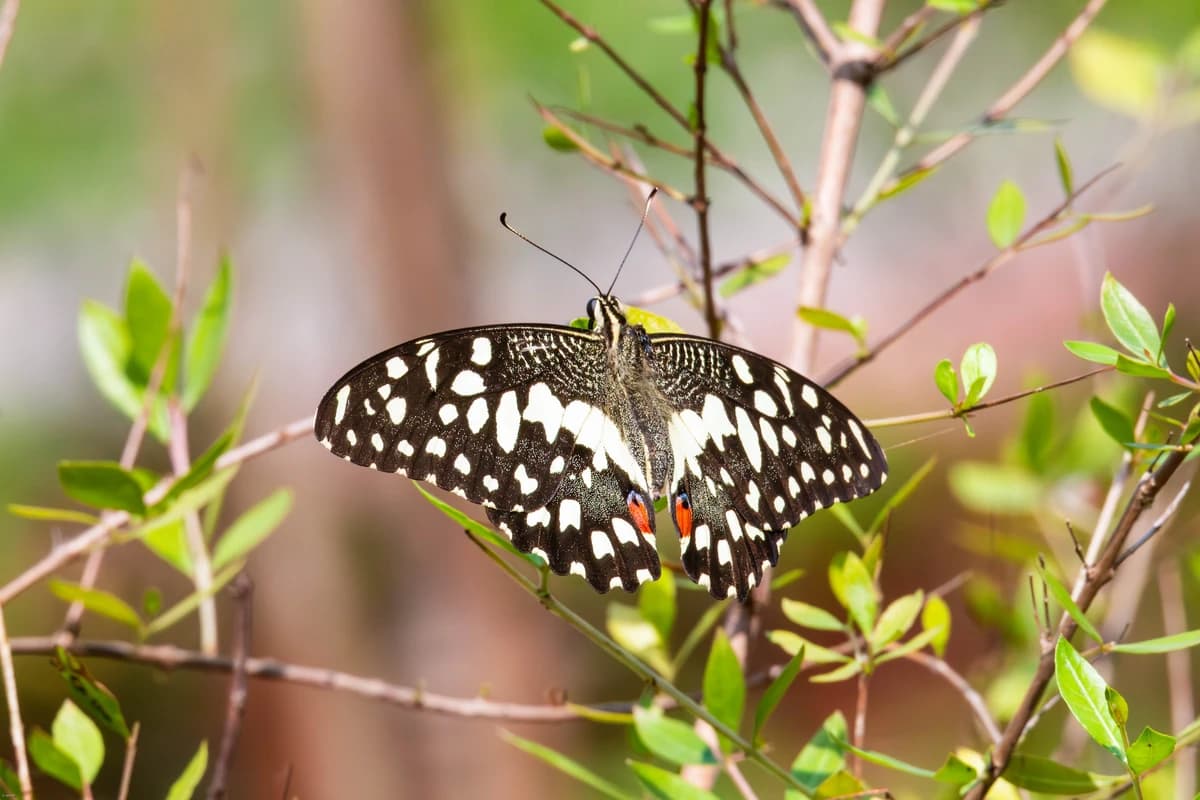
Scientific Name: Papilio demoleus - A beautiful flying jewel of the swallowtail family
The Lime Butterfly is a mesmerizing "flying jewel" of the swallowtail family, though it uniquely lacks the characteristic "tails" on its hindwings.
Its black wings are adorned with a complex tapestry of creamy-yellow spots and bands, making it a standout resident of any garden.
Often found fluttering near citrus trees, this butterfly is a symbol of nature’s delicate artistry and a favorite subject for nature photographers.
Habitat and Distribution
Native to Asia and Australia, the Lime Butterfly has successfully spread to parts of the Caribbean and Central America.
It thrives in diverse environments including:
• Urban gardens
• Citrus orchards
• Open fallow lands
• Evergreen forests
Why It Is So Beautiful
Its beauty comes from its high-contrast coloring and intricate markings.
Wing Patterns:
The upper side features a black background with irregular yellow or white spots and streaks.
Vibrant Eye-spots:
On its hindwings, it features distinct red and blue eyespots near the base, which act as a defense mechanism to startle predators.
Ventral Display:
The underside of its wings displays a pale yellow base with reddish bars and blue-lined black spots.
Unique Characteristics & Behavior
No Tails: Unlike most other swallowtails, this species does not have prominent tails on its hindwings.
Short Lifespan: In its adult stage, it is one of the shortest-lived butterflies. Males often live for only about 4 days, while females live about a week.
Citrus Lovers: Its common names come from its larval host plants — citrus trees like lime and lemon.
While adult butterflies are beneficial pollinators, their caterpillars are known to feed on citrus leaves.
Sun-Seekers: These butterflies are most active during the day and are often seen basking with their wings wide open in the morning sun to warm up.
Captured in the wild — Photography by Al Maruf, Bangladesh.
Photograph and text © Gazi Mahmud Al Maruf
Licence this image